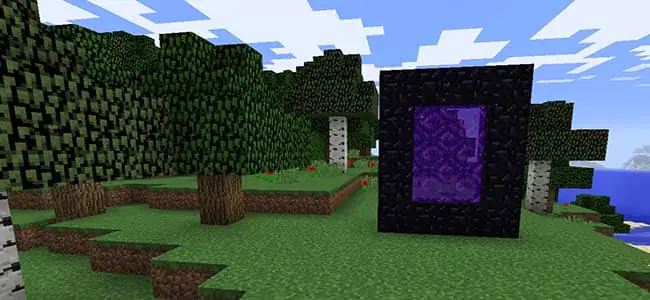
A nether portal frame can be any rectangle from 4 blocks wide by 5 tall up to 23 by 23, and only the obsidian frame itself has to follow the rules. Everything around it is yours to decorate.
Most Minecraft players build simple nether portals like the one in the photo above. However, there are so many other ways to build and design your nether portal!
When you build a larger nether portal it can allow for more decoration around it. This article covers the shape and dimension rules for building a nether portal, design ideas for both large and small builds, and how to make sure the portal you decorated is the one you come back out of. Everything here is current as of Minecraft Java 26.3 and Bedrock 26.50 (Wilderness Bound).
Nether Portal Shapes and Dimensions
In order to be functional, all nether portals must follow these rules on shapes and dimensions:
- Portals must be rectangular and vertical. A nether portal cannot be built flat on the ground like an end portal. If you want a different shape (like a circle), you must use multiple rectangular portals to make the shape or place blocks in front of and behind the obsidian frame.
- The smallest nether portal is 4 blocks wide by 5 blocks tall, and the largest is 23 by 23.
- Only obsidian can be used for the frame, crying obsidian does not work. It is fine to place any block you like in front of and behind the frame to decorate it.
- Corners are not required. You can leave empty air or put any block you’d like in the corners.
- Two portals built next to each other can share the obsidian column between them, which saves 3 blocks per extra small portal on a hub (5 if you fill in the corners).
- Nether portals can’t be activated in the End.
Here is how much obsidian you’ll need for each portal size:
| Frame size | Opening you walk through | Obsidian, no corners | Obsidian with corners |
|---|---|---|---|
| 4×5 (minimum) | 2×3 | 10 | 14 |
| 5×5 | 3×3 | 12 | 16 |
| 7×7 | 5×5 | 20 | 24 |
| 23×23 (maximum) | 21×21 | 84 | 88 |
Flint and steel is the usual way to light a portal, but there are some other ways that also work. Other ways to light a portal are: fire charges, ghast fireballs, lightning strikes, or fire spreading naturally from a flammable block next to the frame. Any fire block inside the frame does the job, on any row, not just the bottom.
The fire has to be the last thing you place. If you light a fire inside an unfinished frame and then place the final obsidian block, the portal does not activate.
Large Nether Portal Designs
Bigger nether portals in Minecraft usually need to be outdoors due to their size. However, if you have a large indoor room, it is possible to build them indoors as well.
Building larger portals offers more flexibility with decorating and you can add things like a nice road leading up to the portal or some accents like nether statues or lava pools. A common design idea is to build around your portal with nether materials like lava, obsidian, and quartz.
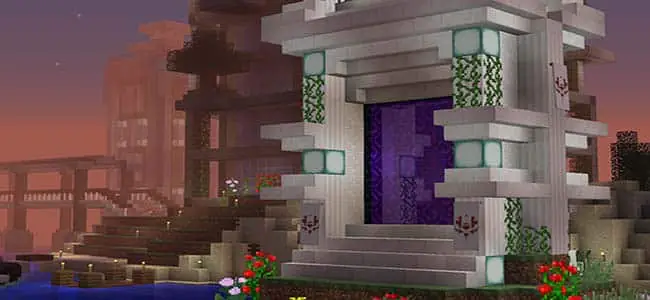
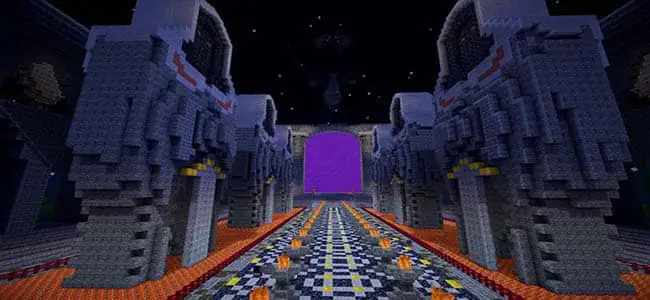
There is one size limit worth knowing before you build bigger on the nether side. If a portal in the Nether is more than 18 blocks wide, the two ends of it are far enough apart that each end can link to a different overworld portal. Walk in on the left and you might come out somewhere else than if you walk in on the right.
Small Nether Portal Designs
Smaller nether portals are usually needed for areas like caves, basements, and inside homes. Even though you are restricted with size, you can still have some decorations and a dedicated room for your portal.
Some ideas are to include a bridge to your portal or create a room with nether decor.
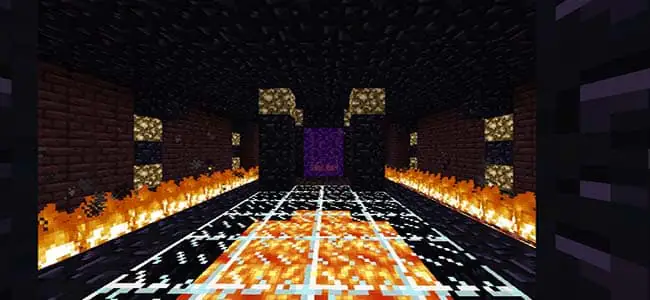
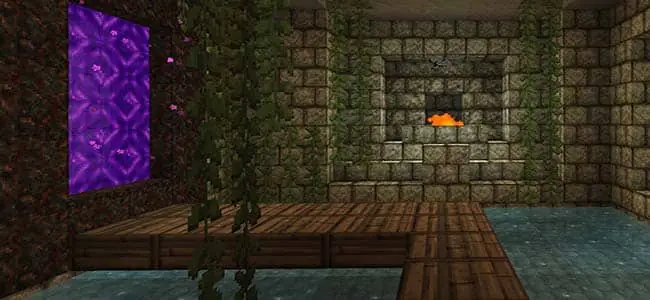
Portal blocks emit a light level of 11, which is more than enough to keep most mobs from spawning in the area around them, so a small portal room mostly lights itself. The one exception is zombified piglins, which the portal spawns on its own (see below).
Nether Portal Location
Although you can build a nether portal almost anywhere in your Minecraft world, it is important to select a good location. Here are some ideas to consider:
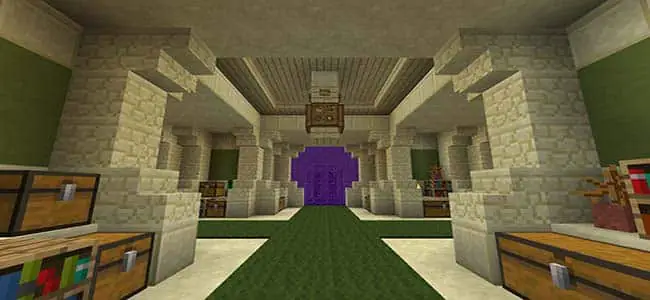
- Building a nether portal near your storage chest room can be convenient. This way, when you return from the nether you can drop off all your items in your chests. An ender chest beside the portal helps too, since whatever you leave in it is still there if the trip goes badly.
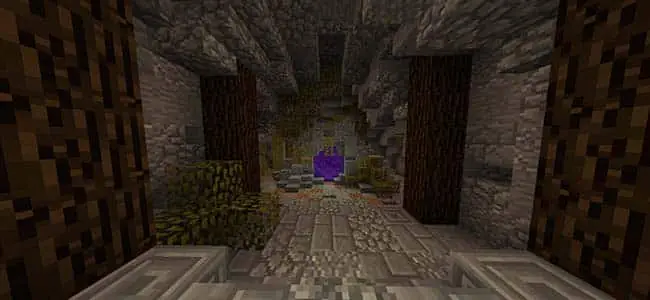
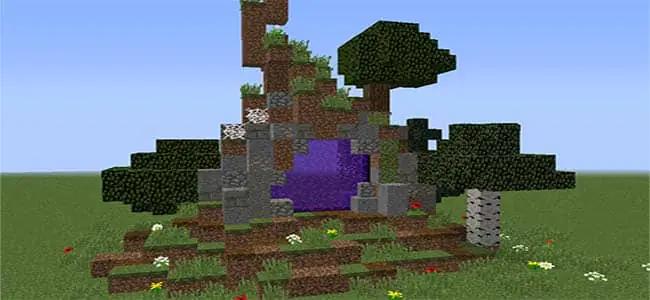
- Nether portals can be blended into the environment around your base. For example, you can put a portal in a cave, the side of a mountain, in the forest, or even in a hill of sand or snow.
- A smaller portal can be placed in an underground room (a good idea if you are building an underground base) or a decorated building above ground. This also contains anything that wanders out of the portal.
- A nice spot to build your nether portal is in a big outdoor garden.
Common Nether Portal Problems
Zombified piglins
An active portal in the Overworld spawns zombified piglins. They do not walk through from the Nether, they appear at the portal, and they keep appearing.
On Java they will spawn on the bottom frame of the portal itself and on Bedrock they spawn on squares next to the portal rather than inside it.
Zombified piglins will spawn twice as often on Normal compared to Easy, and three times as often on Hard compared to Easy. If your portal sits inside a dedicated room, put a door on it. On Java, spawn-proofing the floor won’t stop them, because they appear on the obsidian frame itself. On Bedrock, covering the blocks around the portal with slabs or carpet helps. See our guide on how to stop mobs from spawning for the blocks that stop mob spawning.
Water and explosions
Portal blocks are fragile even though obsidian is not. A bucket of water emptied into the frame removes the portal blocks and shuts the portal off. Explosions also turn off portals, including creepers, TNT, or a ghast fireball on the nether side. The obsidian survives explosions, but you have to re-light the frame to turn it back on.
It’s recommended not to build a decorative water feature next to the portal where it can flow in. And on the nether side, box the frame in with stone or stone bricks so ghast fireballs cannot reach the portal blocks.
Blocks for Decorating a Nether Portal
| Look | Blocks to use | Added in |
|---|---|---|
| Classic nether | Netherrack, nether bricks, red nether bricks, blackstone, basalt, magma blocks, shroomlight | Base game and 1.16 |
| Volcanic | Sulfur and cinnabar, both with full stair, slab, wall, polished, brick, and chiseled sets | Chaos Cubed, June 2026 |
| Autumn | Poplar wood, red shrubs, leaf litter, and shelf mushrooms, for a portal tucked into a dappled forest | Wilderness Bound, September 2026 |
| Modern | Concrete with the new concrete stairs and slabs, plus glass | Wilderness Bound, September 2026 |
| Industrial | Copper at any oxidation stage, copper bars, copper chains, copper lanterns, copper torches with their green flame, a copper golem statue as a guardian | The Copper Age |
| Ghostly | Pale oak, pale moss, pale hanging moss, resin bricks for orange accents | The Garden Awakens |
| Crystal | Amethyst blocks and clusters, tinted glass, crying obsidian for its purple glow | 1.16 and 1.17 |
| Colorful | Quartz, glazed terracotta, stained glass behind the frame | Base game |
Frequently Asked Questions
How do you make a nether portal without a diamond pickaxe?
Cast the frame in place instead of mining it. Obsidian forms wherever water touches a lava source block, so you can build the whole frame by pouring water over lava in the right shape and never mine a single block of it. You will need a bucket and a lava source, and it takes some effort to get the shape right, but it works from day one of a world.
What happens if your portal breaks while you are in the Nether?
You are not stuck, but you can’t make obsidian there, because water evaporates the moment you place it in the Nether. If the frame is still standing, just relight it, which is why it’s smart to always carry a flint and steel. If the frame itself is gone, piglins trade obsidian for gold ingots, and ruined portals in the Nether are free obsidian if you find one.
Can mobs and items travel through a nether portal?
Yes. Almost everything can go through except the wither and the ender dragon, including hostile mobs, animals, and items you throw in. Mobs travel instantly rather than waiting four seconds, then get a 15 second cooldown before they can use a portal again. Minecarts and boats only wait half a second.
Why do you sometimes come out of a portal facing the wrong way?
Because the two portals are built at right angles to each other. On Java, a destination portal turned 90 degrees from the source rotates you 90 degrees as you arrive, so a round trip without touching your mouse spins you a full 180. Build both frames on the same axis and it stops happening.
Do nether portals cause lag on a server?
They can. On Java, every trip through a portal keeps the chunks around the destination fully loaded for 15 seconds, and that timer resets each time anything passes through, including mobs wandering back and forth on their own. A busy portal with mobs on both sides effectively becomes a permanent chunk loader. On a server with a lot of player portals, that adds up.
That concludes our top design ideas for building nether portals in Minecraft. Do you have any suggestions or additions? Leave a comment below!
TheHypnoAlien
Tuesday 20th of March 2018
Thanks for the tip for these nether portal areas for designs, this will go great for my videos, I'll be sure to link this down in the Bio of my next video.