The best automatic farms to build first are an egg farm (the easiest), then a sugar cane farm, then a semi-automatic crop farm. Once those are running, the crafter block and the copper golem can automate your crafting and storage too. This guide covers all of them, current as of Minecraft Java 26.3 and Bedrock 26.50 (Wilderness Bound).
Automatic farms in Minecraft make your life easier by generating things like blocks, items (especially food), or experience. Depending on the design, these farms can be either fully automatic (plant, harvest, and store items) or semi-automatic (some but not all steps are automatic). Either way, these farms are an amazing thing to build and a way to automate repetitive tasks!
Over the years, Minecraft has received many updates which have changed how to best design these farms. The addition of blocks like observers have really changed the game and have allowed for way more automation. Observers can detect when crops have grown and then trigger redstone signals for harvesting. You can read more about observers here. More recently, the crafter block and the copper golem have made it possible to automate crafting and item sorting as well, which we cover at the end of this guide.
This guide will go over the most popular and common designs when it comes to automatic farms in Minecraft, including things like wheat, sugar cane, pumpkins, and eggs. If the guide is popular, I will add more types of auto farms to it!
What Order Should You Build Automatic Farms?
If you are just starting out, build your farms in this order: egg farm first (cheapest and easiest), then a sugar cane farm (paper for books and trading), then a semi-automatic wheat farm for food. After that, add a pumpkin or melon farm and connect everything to your storage with hoppers.
Each farm makes the next one easier. Your sugar cane feeds your enchanting table, your wheat feeds your animals, and once you add a crafter and a copper golem at the end, your whole base practically runs itself!
Semi-Automatic Wheat Farm
For wheat farming, it is easier to create a semi-automatic farm first as it is much simpler and needs less materials. This type of farm requires manual planting of seeds but the harvesting, collecting, and storage of crops is automated. This kind of design works with all similar crops such as beets, carrots, and potatoes. It does not work with melons or pumpkins as they need a different design using pistons.
The general idea is to make a very long “staircase” of farmland that water can flow down. Crops are planted in the farmland and once fully grown, water can be released from the top to flood the crops. Flowing water harvests these crops instantly while also pushing the crops to a central point for collection.
A cool idea could be to have the items flow in a stream directly to a hopper connected to a storage area!
Extra wheat is more useful than ever, too. Nine wheat makes a hay bale, and since the Wilderness Bound drop, 3 hay bales craft into 4 straw beds, which let you sleep while exploring without moving your spawn point.
For a tutorial of how to make this kind of farm, check out the below YouTube video.
Fully Automatic Wheat Farm (Villagers)
Using a more complicated technique with villagers, it is possible to create a 100% automatic crop farm for wheat. A farm like this will also work with similar crops like carrots, beets, and potatoes. This setup requires a stronger knowledge of how to use redstone and will also need a farmer villager (a villager that has claimed a composter) to handle the seed planting.
Check out the below YouTube tutorial on how to build a farm like this.
Read more: 14 Classic Minecraft Modpacks Still Worth Playing
Automatic Egg Farm
Building an egg farm is one of the easiest automatic farms you can build in Minecraft. Due to the small size, this is an automatic farm that would easily fit inside any survival Minecraft house.
Chickens continuously lay eggs, so it is only a matter of keeping the chickens locked in one small area and using hoppers for collection. One cool idea is to build a “chicken coop” out of wood with about a 3×3 or smaller floor of hoppers. This floor will collect all the laid eggs into a chest under or beside the coop.
To get chickens into the coop, all you need to do is throw eggs into it and this will occasionally spawn chickens. Eggs can be thrown by right clicking with an egg in your hand. It is easy to start with just a few chickens and then throw the eggs they lay back into the coop to spawn more.
If you want to decorate the floor a bit more, carpets can be placed on top of the hoppers to hide them.
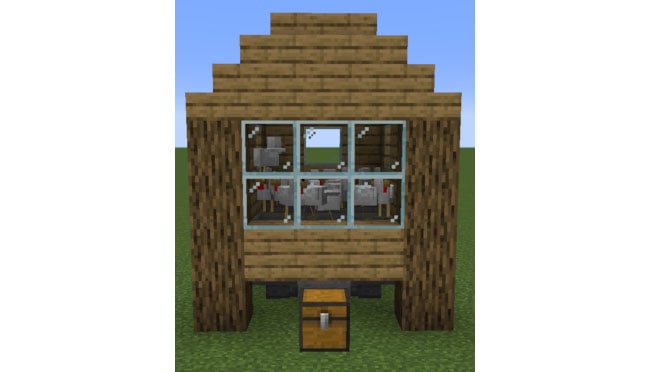
An example of a chicken egg farm. The chickens are stuck in an enclosed 3×3 space with a floor made of 9 hoppers. Every egg laid gets collected by the hoppers into a chest.
Short on iron for all those hoppers? Start with a single hopper instead. Several chickens can share the same one-block space, so a 1×1 pen on top of one hopper, with a chest below it, collects eggs from every chicken inside.
Automatic Sugar Cane Farm
An automatic farm for sugar cane is fairly easy to make, but you will need to use some redstone for this one. Since sugar cane constantly regrows (as long as you don’t harvest the bottom block) you don’t have to worry about re-planting at all.
The harvesting of the sugar cane is handled using observers, pistons, and redstone. An observer is a block which sends a redstone signal as soon as a new block appears in front of it. In our case, the redstone will turn on when the sugar cane grows three blocks tall and this will activate the pistons to chop off the second sugar cane block. This will leave the bottom block intact and allow the plant to constantly regrow.
Once broken by the pistons, the sugar cane falls onto the dirt and a hopper minecart will vacuum these up as it travels back and forth (see photo below). To get the minecart to travel back and forth, you just need to place the minecart onto a powered rail above a redstone block. For longer builds, you will need to add multiple redstone blocks.
This kind of farm works with other similar growing crops as well (such as bamboo).
I’ve built a sugar cane farm to show you how it works and feel free to copy this build into your game. Note that the build can be expanded as far as you want in each direction and it can also be mirrored to be double-sided if you’d like. The build I have in the photos is four blocks deep, excluding the chest in the front.
Components by Level (Front to Back)
- 1 (Top): Glass, empty air, observers, redstone dust/wire
- 2: Glass, empty air, pistons, glass
- 3: Glass, sugar cane, glass, glass
- 4: Glass, dirt, water, glass
- 5: Glass, powered rails & one minecart with hopper, glass, glass
- 6 (Bottom): All stone, except for one redstone block under the rails, two hoppers, and a chest
Front View
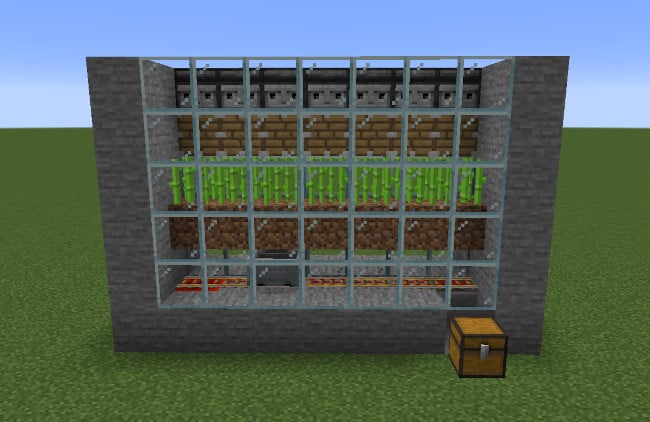
Front view of an automatic sugar cane farm.
Back View
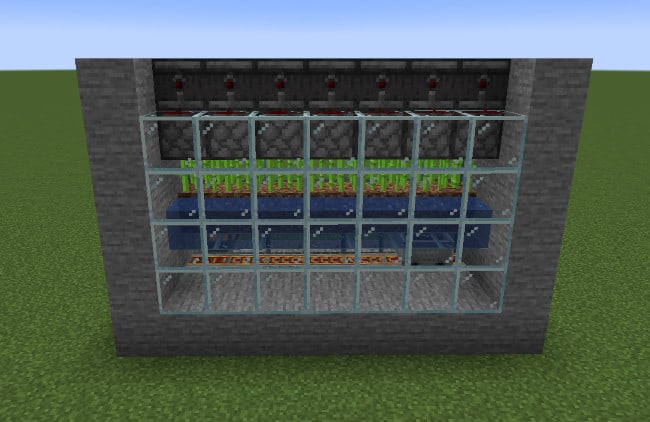
Back view of an automatic sugar cane farm.
Read more: 34 Cool Things to Build in Minecraft When You’re Bored
Automatic Bamboo Farm
Bamboo grows even faster than sugar cane, and the same observer and piston design works for it! Just swap the sugar cane for bamboo. Bamboo doesn’t need water next to it, so you can skip the water row if you like, and the observers and pistons will handle the rest.
Why farm bamboo? It is a surprisingly useful crop: bamboo can be crafted into blocks of bamboo and then planks for building, used as furnace fuel, crafted into scaffolding, and fed to pandas. Since it grows so quickly, even a small automatic bamboo farm will fill chests fast.
Automatic Pumpkin & Melon Farm
Pumpkins and melons grow differently than other crops as they grow horizontally from a vine and do not require replanting. These crops are also “solid blocks” you can’t walk through which is another difference from crops like wheat or sugar cane.
To build an automatic pumpkin or melon farm in Minecraft, you’ll need to use pistons, observers, and redstone.
I found a great video on YouTube explaining how to build this kind of farm. You can find it below.
For more information on automatic pumpkin and melon farms in Minecraft, check out this detailed Minecraft Wiki article.
Automatic Crafting with the Crafter Block
The crafter is a block that crafts items automatically when it receives a redstone signal. It was one of the biggest additions for farm builders in years! You craft one with 5 iron ingots, 1 crafting table, 1 dropper, and 2 redstone dust.
Here is how it works: open the crafter and set up a recipe in its 3×3 grid (you can lock slots you don’t want used). Feed it ingredients with hoppers, give it a redstone pulse, and it crafts and ejects the finished item. Connect the output to another hopper and chest, and your farm now delivers finished products instead of raw materials.
Some great ways to use the crafter with the farms in this guide:
- Feed your sugar cane farm’s output into a crafter making paper. Add a second crafter and some leather for fully automatic books!
- Turn your bamboo farm’s output into blocks of bamboo, then use a second crafter to turn those into planks for building.
- Compress crops like wheat into hay bales so your storage doesn’t overflow.
Automatic Item Sorting with the Copper Golem
Every automatic farm eventually creates a new problem: chests full of unsorted items. The copper golem solves this without any redstone at all. It was added in the Copper Age drop (Java 1.21.9) and works like a tiny walking storage assistant.
To make one, place a copper block on the ground and put a carved pumpkin (or jack o’lantern) on top. The golem spawns along with your first copper chest. After that, you can craft more copper chests by surrounding a regular chest with copper ingots.
The golem’s job is simple: it takes items out of copper chests (up to 16 at a time) and carries them to nearby regular chests that already hold the same item. If it finds an empty chest, it starts a new category with whatever it’s holding. Route your farm’s hoppers into a copper chest, walk away, and come back to sorted storage!
A few tips: the golem oxidizes over time like any copper block, so use a honeycomb on it to wax it (or an axe to scrape it clean). Golems only sort while the area is loaded, so keep your storage near your base. For more on everything copper, check out our full Minecraft copper guide.
Frequently Asked Questions
Do automatic farms work while you are away?
Farms only run while their chunks are loaded. On Java, crops and sugar cane only grow within your simulation distance, which is usually shorter than your render distance, so stay fairly close to your farms. On multiplayer servers, farms keep working as long as any player keeps the area loaded.
Why aren’t the crops in my farm growing?
Check light and water first. Crops need a light level of 9 or more to grow, so light up indoor and underground farms, and farmland needs water within 4 blocks to stay hydrated. Also make sure nobody jumps on the farmland, since that turns it back into dirt.
Does bone meal work on sugar cane?
Only on Bedrock, where one use grows sugar cane to full height. On Java, bone meal does nothing to sugar cane, so an automatic farm is the only way to speed it up. Bone meal works on bamboo in both editions.
And that’s all for now! If you have any suggestions for other automatic farms I should add to this page, feel free to add a comment below.
ivan
Saturday 26th of August 2023
really cool i could use this for my minecraft world
Henry perkins
Saturday 18th of March 2023
good stuff