Terraforming in Minecraft means reshaping the land before you build on it. There are three steps: shape the ground first, texture it second, add detail last.
When building in Minecraft, it is common that you will need to do some terraforming and landscaping to the natural environment. This could be as simple as flattening land prior to building a house or more complicated like building a lake or mountain.
This guide will help you with tips on how to do landscaping and terraforming in Minecraft more effectively. Everything here is current as of Minecraft Java 26.3 and Bedrock 26.50 (Wilderness Bound).
How to Flatten Land in Minecraft
When playing on survival mode without mods, you will have to flatten the landscape manually. This can seem like a lot of work, but can be sped up with higher quality tools (like netherite shovels), efficiency enchanted shovels, and beacons.
Using better tools is obvious, but a lot of players forget about beacon buffs! When activating the haste II buff on a beacon in combination with efficiency tool enchants, you can break most blocks nearly instantly (including stone).
The fastest way to flatten land in Minecraft will always be to use Minecraft commands, a tool like WorldEdit, or creative mode. When using WorldEdit, you can select a cubic area to clear an area and with creative mode you can break any block instantly without tools.
How to Terraform Hills in Minecraft
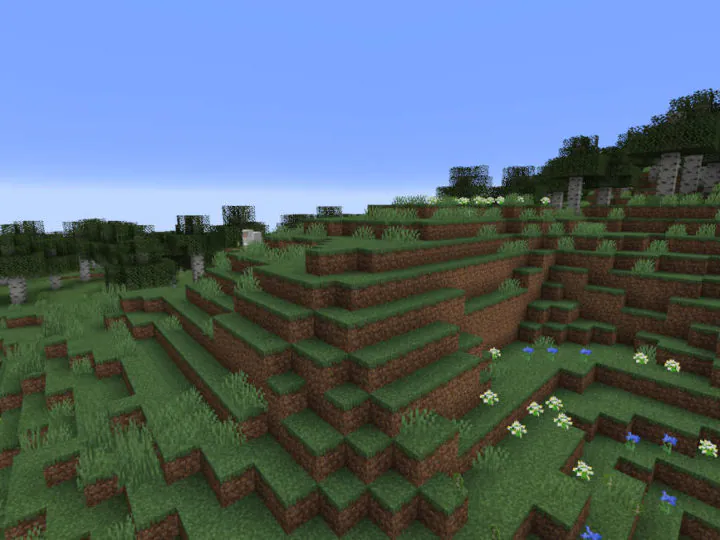
To terraform a hill in Minecraft to make it look more pretty, you should smooth out each layer of the hill one by one. Natural world generation tends to create very jagged and random terrain, whereas in real-life, hills tend to be smoother due to many years of natural shaping from the environment. Try to make long, sweeping lines and circles to remove this jaggedness from hills.
If you’re looking to landscape a brand new hill or expand upon a hill to make it taller, you should follow similar logic. Build the hill layer by layer starting from the bottom and gradually work your way up to the desired height. For a steeper hill, leave less room between each layer.
In general, when terraforming you should not keep more than about seven blocks in a straight line on anything that is meant to look natural. Straight edges are what make a hand-built hill look unnatural. Break every long stretch of blocks with a step in or out, even a single block.
Two other habits that make a hill look more natural:
- Vary your layer thickness. If every step up is exactly one block over two blocks, you get a staircase. Mix one-block steps with two and three-block runs at random.
- Double-layer the surface. Put dirt under your grass rather than laying a single layer of grass over air or stone. A single layer means an enderman picking up one block leaves a hole straight into whatever is underneath!
How to Terraform Lakes, Ponds, and Rivers in Minecraft
Creating a new body of water in the world can be challenging, especially if you don’t want it to look artificial. Often water landscaping is needed when you are adding a garden to your base. You should follow similar logic as building a hill, but in this case you’re digging down instead of building upwards.
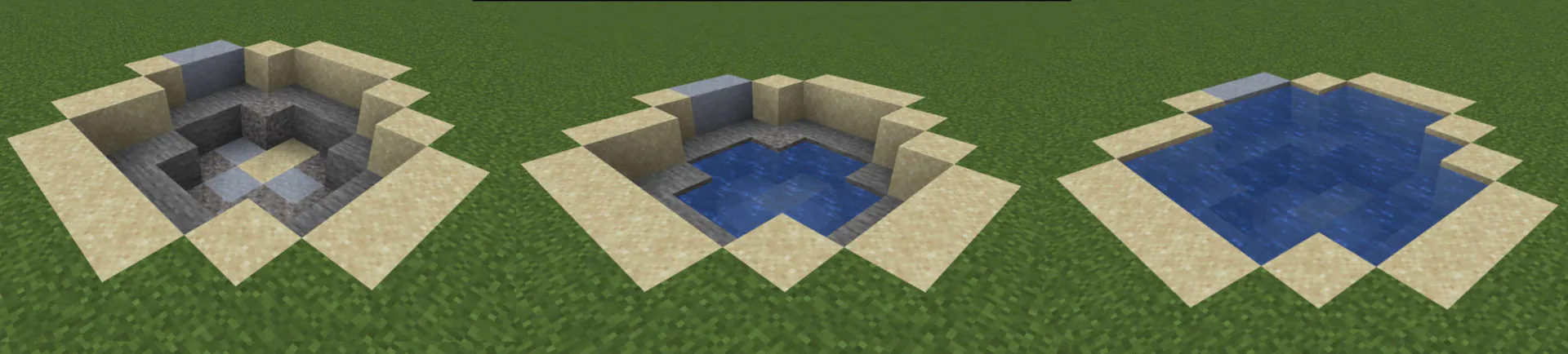
In the photo above, you can see the steps needed to build a pond in Minecraft. The pond is gradually deeper towards the middle and uses sand, clay, stone, and gravel to give the area a more natural appearance.
Here is some additional guidance on how big to build your terraformed body of water:
- Ponds: Shallow water (around 1-3 blocks deep) and not too wide
- Lakes: Slightly deeper water (1-3 blocks deep at the shore and much deeper in the middle). Larger in size than a pond and may take on different shapes like an oval or crescent
- Rivers: Long and narrow, 1-2 blocks deep at the edges and deeper down the middle channel
You do not have to fill every block by hand. Any block with two water sources touching its sides, sitting on a block water cannot flow through, turns into a source block itself. So on a sealed, solid bottom you can place water in a checkerboard pattern and the gaps fill themselves in. That halves the number of bucket trips on a large pond.
As a decoration, it can be a good idea to construct a bridge to cross your new pond!
How to Texture Terrain
Build gradients, not edges
Pick one main block, two or three “blend blocks”, and a detail layer. Scatter the blend blocks into the main block type in patches rather than bands.
Here are some ideas for blocks to use when terraforming in Minecraft:
| Terrain | Base | Blend into it | Detail on top |
|---|---|---|---|
| Grassy hill | Grass block | Coarse dirt, podzol, rooted dirt, dirt path | Leaf litter, bush, wildflowers, short grass |
| Autumn forest | Grass block | Coarse dirt, podzol | Leaf litter, red shrubs, fallen poplar logs with shelf mushrooms |
| Stone cliff | Stone | Andesite, cobblestone, gravel, tuff | Moss carpet, glow lichen, vines, hanging roots |
| Sandy shore | Sand | Gravel, clay, dirt, sandstone | Dead bush, short dry grass, cactus flower |
| Snowy slope | Snow block | Snow layers, powder snow, calcite, packed ice | Spruce leaves, pale moss carpet |
| Swamp edge | Mud | Packed mud, clay, coarse dirt, muddy mangrove roots | Firefly bush, lily pads, hanging roots |
| Volcanic | Blackstone | Basalt, tuff, gravel, magma blocks | Sulfur and cinnabar for yellow and red streaks |
If you have laid seven of the same block in a row anywhere a player will walk, swap one out.
Ground Cover Blocks
The Spring to Life update added lots of extra ways to landscape and these new blocks exist to help you decorate the ground. Here are some ground cover blocks to use:
- Leaf litter. Smelt any type of leaves in a furnace and you get it. Up to four pieces fit in one block space, each at a different rotation, so you can go from a light dusting to full coverage. Note that it is tinted by the biome it sits in, so the same block looks different in a forest and in a badlands
- Wildflowers. Also four to a block. Bone meal on wildflowers makes more wildflowers, so one patch seeds a whole meadow
- Bush. A small shrub for filling the gaps between trees, found in plains, forests, birch forests, rivers, and windswept hills
- Firefly bush. Grows near water. Emits firefly particles whenever the light level at its position is 13 or lower, spreading up to five blocks around it on Java
- Short and tall dry grass. For deserts and badlands. Worth knowing that both are one block high, unlike regular tall grass which is two
Firefly bushes also give off a very faint light level of 2. That only reaches a block or so around the bush, so don’t count on them to keep mobs from spawning.
Fallen trees also generate naturally now, which means a log lying on its side in your forest looks like normal world generation rather than something you placed.
The Wilderness Bound drop added a few more natural details that work anywhere, not just in the new dappled forest:
- Red shrubs. A low autumn-colored bush. Bone meal on one grows another next to it, so you can spread a patch quickly
- Shelf mushrooms. Small brackets that grow on the sides of logs, which make fallen logs look much older and more natural. Bone meal turns a small one into a large one
- Poplar trees. Plant poplar saplings for red, orange, and yellow trees. The color is random, so plant a few together for a natural autumn mix
Commands and Tools for Large Projects
Vanilla commands can be more helpful than people expect, and they work on any world with cheats on:
/fill x1 y1 z1 x2 y2 z2 blockfills a box. By default the limit is 32,768 blocks per command, which is exactly 32 by 32 by 32, so plan large jobs in 32-block bites./fill x1 y1 z1 x2 y2 z2 coarse_dirt replace grass_blockswaps one block type for another and leaves everything else alone. This is one of the most useful terraforming commands./clonecopies a shape you already like somewhere else, which is how you get three similar hills that are not identical./setblockfor one block at a time, usually somewhere you cannot reach.
Frequently Asked Questions
Does terraforming change the biome?
No. Biomes are set when the world generates and placing blocks does not change them. Build a jungle in the middle of a desert and it stays a desert (the grass keeps the desert color, desert mobs keep spawning, it still never rains, and any leaf litter you place keeps desert colors). On Java you can force a change with the /fillbiome command. Otherwise, pick terrain that already matches what you want to build. Our list of Minecraft biomes is a good place to start looking.
How do you make a waterfall look natural?
Place a single source block at the top and let it fall on its own rather than building a column. Then work on the bottom by widening the pool, place a ring of gravel, and add a moss carpet. Real water erodes what it lands on, so the base should look messier than the top.
What is the fastest way to drain a lake?
Sponges. One dry sponge soaks up the water around it instantly, and a wet sponge dries out again in a furnace so you can reuse it. You’ll find them in ocean monuments. Other than that, fill the whole body with sand or gravel so it falls to the bottom and pushes the water out, then dig the sand back up. Filling by hand with dirt works too but it can be time consuming.
That concludes our guide to terraforming and landscaping in Minecraft. What are you reshaping? Leave a comment below!